The Short Answer
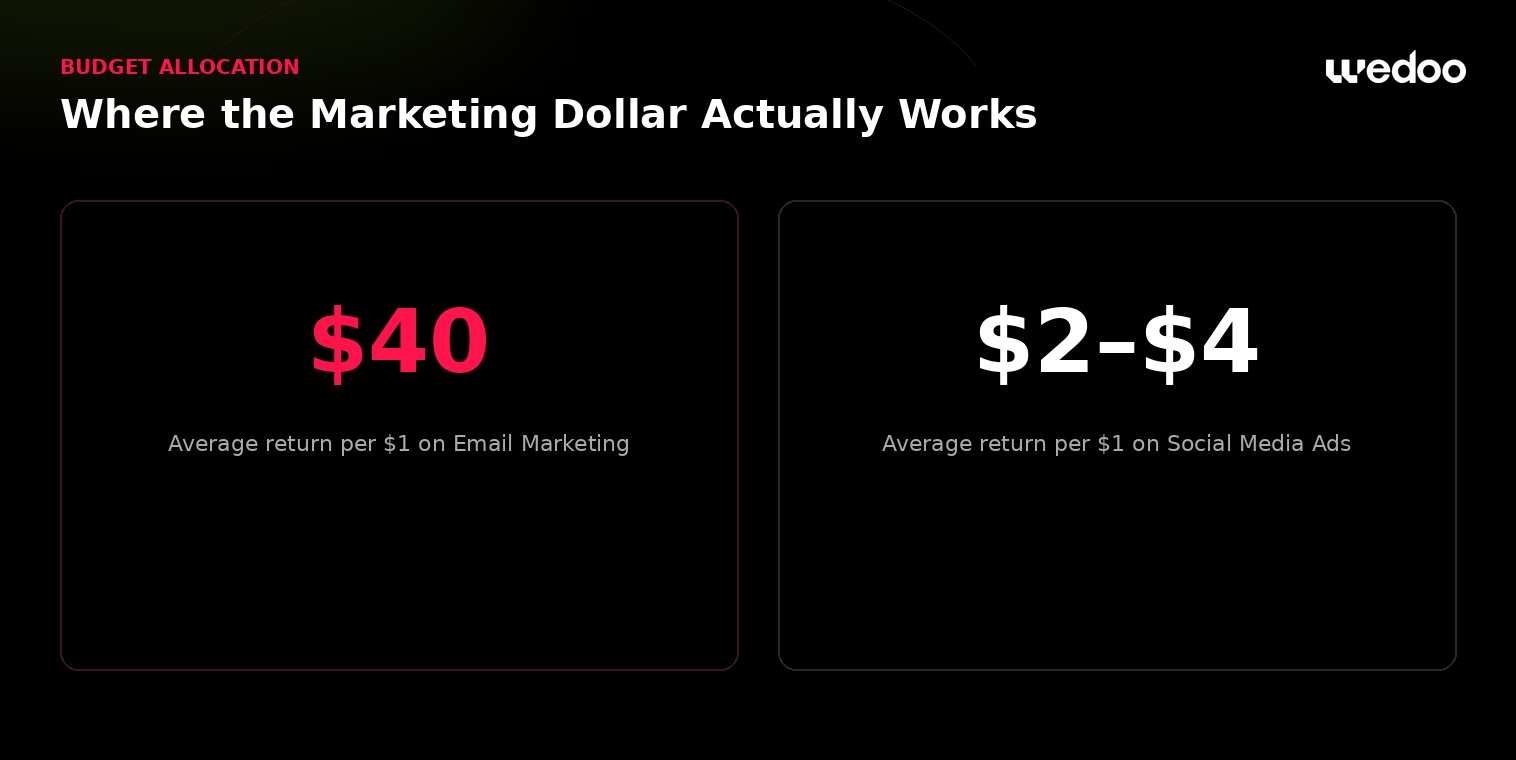
Most businesses should put more of their marketing budget into email than they currently do, and less into paid social than they think. Email marketing delivers an average return of roughly $36 to $42 for every $1 spent, compared to around $2 to $3 per $1 on paid social and search. Social media still earns a place in the budget, but its job is discovery and brand awareness, not direct revenue. The two channels are not really competing for the same job, which is exactly why treating this as an either/or question causes most of the wasted spend we see.
That distinction, job versus channel, is the part most budget conversations skip. We will get into exactly how to split the money in a moment, but first you need to know what each channel is actually built to do.
What Each Channel Is Actually For
Think about the last time a brand actually got you to buy something. Chances are it was one of two moments: you saw a product somewhere in your feed and got curious, or you got an email at exactly the right time with an offer you were already half-considering. Those are two different jobs, done by two different tools.
Social media is a discovery engine. It puts your brand in front of people who have never heard of you, using interest and behaviour signals instead of intent. Someone scrolling Instagram is not looking to buy. They might stop, might follow, might remember your name three weeks later when they finally need what you sell.
Email is a conversion engine. Everyone on your list already gave you permission to contact them. They know your brand, they opted in, and when you send the right message at the right time, they are far more likely to act immediately. It is the closer, not the opener.
Confusing the two jobs is where budgets go wrong. Expecting social to close sales the way email does sets you up to call a channel “underperforming” when it was never built for that job in the first place.
The Real Numbers: ROI, Cost, and Reach
Here is where most advice gets vague. Let's not do that. These are the numbers that should actually inform your split.
Factor | Email Marketing | Social Media | |
Average ROI | $36-$42 per $1 spent | ~$2-$3 per $1 spent (paid) | |
Conversion rate | ~4.2% average | ~0.5-0.6% average | |
Organic reach today | Near 100% of your list (deliverability aside) | 2-9% of followers, platform dependent | |
Cost to scale | Low and mostly fixed (platform fee) | Rises directly with ad spend | |
Who owns the audience | You do, fully | The platform does | |
Primary strength | Retention, repeat revenue, direct sale | Discovery, awareness, brand reach |
Why Email Still Wins on ROI
The number worth remembering is this: email marketing delivers an average return of $36 to $42 for every $1 spent, and for retail and ecommerce brands specifically, that climbs to around $45. Some optimised programs report returns above $70. Compare that to paid search at roughly $2 per $1 and paid social advertising at around $2.80, and the gap is not close.
The reason is structural, not tactical. Your list is made up of people who already raised their hand. They gave you their email address, which is a small but real act of trust. When you message them, you are not fighting an algorithm to be seen. You are landing directly in a space they check multiple times a day, and you own that relationship permanently. No platform can take it away, throttle it, or change the rules on you overnight.
Automation multiplies the return further
Automated flows, welcome series, abandoned cart emails, post-purchase follow-ups, consistently outperform one-off campaigns by a wide margin. Set up once, they keep earning without additional weekly effort, which is exactly the kind of compounding return a lean marketing budget should be chasing.
Why Social Still Earns a Budget Line
None of this means cut social to zero. That would be the wrong lesson.
Organic reach on social has collapsed almost everywhere. Facebook Page reach now sits around 2% of followers, down from double digits a decade ago. Instagram feed posts reach roughly 3.5 to 9% of followers depending on format. That decline is not a reason to abandon the channel, it is a reason to stop expecting organic posting alone to drive revenue, and to be deliberate about what you are actually paying social to do.
What social still does better than any other channel is put your brand in front of people who have never searched for you and never will, until they see you first. It builds the awareness that eventually feeds your email list, your search rankings, and your word-of-mouth. Cutting it entirely starves every other channel of new people to eventually convert.
The mistake is measuring social by the same yardstick as email. Judge it on reach, engagement, and how many new people it hands off into your funnel, not on immediate ROI.
The Budget-Split Framework: How Much Goes Where
There is no single correct ratio for every business, but there is a sensible starting framework based on what each channel is proven to do well.
1. Fund the closer first
Before adding a single dollar to social ad spend, make sure your email program is fully built out: welcome series, abandoned cart flow, post-purchase sequence, and a consistent weekly send. This is your highest-return spend and it is often the most underfunded, because it is less visible than a scroll-stopping ad.
2. Size your social spend to your discovery need
If your business already has strong word-of-mouth or search visibility, social can run lean, mostly organic plus a small always-on budget to test creative. If you are newer or entering a competitive category, discovery matters more, and social deserves a larger share to build the audience email will eventually convert.
3. Treat paid social as a top-of-funnel investment, not a sales channel
Measure paid social campaigns on cost per new lead or new list signup, not immediate purchases. When you stop expecting it to behave like email, the “underperforming” feeling usually disappears, because you are finally measuring it against the job it was actually built for.
4. Revisit the split quarterly
A business with a thin email list should temporarily lean toward social to build that list faster. A business with a large, underused list should shift dollars toward email until the automation flows are fully built out. The right split moves as your assets change.
Signs You're Overspending on Social
• You have an email list you rarely message, or send to less than once a month.
• You have no welcome series or abandoned cart flow set up.
• Your paid social cost per acquisition keeps climbing and nobody has asked why.
• You are judging social posts by direct sales instead of reach and new leads.
Signs You're Underspending on Email
• Your list has grown but your sending frequency has not.
• You have never set up a single automated flow.
• You are not segmenting, everyone gets the same email regardless of purchase history.
• You do not know your email-attributed revenue at all.
The AI Shift: AI Answers and Owned Data
Here is the part almost nobody is factoring into their budget conversation yet. As AI tools and AI-powered search overviews become a bigger part of how people research and buy, the value of an owned, permission-based audience goes up, not down.
Social platforms control what you can say, who sees it, and increasingly, whether AI systems can even access that content at all. Your email list has none of those constraints. It is a direct line to real customers that no algorithm change, platform policy update, or AI crawler restriction can take away from you.
This is not a reason to abandon social, discovery still has to happen somewhere. It is a reason to treat your email list as the asset you are actually building toward, not an afterthought sitting under your social strategy.
How to Decide for Your Business
If you take nothing else from this guide, take this sequence. First, check whether your email automations exist at all. If they do not, that is your highest-leverage next step regardless of your total budget size. Second, look at where your list growth is actually coming from, because that tells you whether social is doing its discovery job. Third, stop comparing the two channels on the same metric. One is built to introduce you, the other is built to close.
FAQs About Email Marketing vs. Social Media Budgets
Q: Should I stop spending on social media and put everything into email?
A: No. Email typically delivers a far higher direct ROI, but social still does the discovery and awareness work that eventually feeds your email list. The goal is a deliberate split, not eliminating either channel.
Q: What percentage of my marketing budget should go to email?
A: There is no universal number, but most businesses under-invest in email relative to its return. A reasonable starting point is to fully fund your core email automations first, since they are typically your highest-ROI, most underused asset, before scaling paid social spend.
Q: Why does email have such a higher ROI than social media?
A: Email reaches people who already opted in and trust your brand, with conversion rates around 4.2% compared to roughly 0.5% to 0.6% on social. You also are not paying an algorithm for visibility the way you are with organic or paid social reach.
Q: Is organic social media still worth doing if reach has dropped so much?
A: Yes, but treat it as a brand and discovery channel, not a direct sales channel. Judge it on engagement and new audience growth, and let email handle the conversion.
Q: How do I know if my business needs more social spend or more email spend right now?
A: If you have a sizable email list you rarely message and no automated flows, fix email first. If your list is small and you have little brand awareness, social deserves a bigger share to build the audience email will later convert.
Closing
Email marketing and social media are not rivals fighting for the same budget line. They are two tools with two different jobs: one introduces you to people who have never heard of you, the other closes the sale with people who already trust you. Fund both, but fund them for what they actually do, and the “where should our budget go” question gets a lot easier to answer.