AI search engines such as ChatGPT, Gemini and Google AI Overviews recommend businesses they can clearly identify, verify and see mentioned by other trusted sources. To be recommended, make your business easy to find (complete, consistent profiles), easy to understand (plain-language pages that answer real questions) and easy to trust (fresh reviews and third-party mentions).
The way customers find businesses has changed fast. Instead of scrolling ten blue links, more people now type a full question such as "who's a good accountant near me that works with small restaurants?" and read the answer an AI writes for them.
The numbers show how quickly this has happened:
Google says AI Mode passed one billion monthly users within a year of launch (Google, May 2026).
ChatGPT reached 900 million weekly active users in February 2026 (Wikipedia, citing OpenAI).
45% of US consumers have used ChatGPT or other AI tools to get recommendations for local businesses (BrightLocal Local Consumer Review Survey 2026).
There's a catch. When Google shows an AI summary, people click a regular search result in only 8% of visits, compared with 15% when there is no summary (Pew Research Center, 2025). If the AI answer doesn't mention you, many customers never reach the list of links where you rank.
How do AI search engines decide which businesses to recommend?
AI answer engines don't have a secret list of favourite businesses. They put together an answer from sources they can crawl and trust. In practice, they look at three things:
Can I find this business? Google's AI features draw on Google's own index and Business Profiles. ChatGPT search uses its own crawler (OAI-SearchBot) alongside third-party search providers. Microsoft Copilot relies on Bing. If a crawler can't reach your site or profile, you can't be recommended.
Do I understand what it does, where and for whom? Vague pages ("we deliver excellence") give an AI nothing to quote. Specific pages ("emergency HVAC repair in Matthews and Mint Hill, same-day, 7 days a week") do.
Do other sources agree it's good? AI answers lean on consensus: reviews, local news, directories, industry lists and forum discussions. One claim on your own website counts for less than the same fact repeated across independent sites.
Classic SEO still matters here. Most of what helps you rank in Google also helps you appear in AI answers. The difference is that AI engines reward clarity and corroboration even more heavily than traditional rankings do.
Not sure how AI sees your business right now?
We'll ask ChatGPT, Gemini and Google AI the same questions your customers ask, and show you exactly where you appear and where your competitors do.
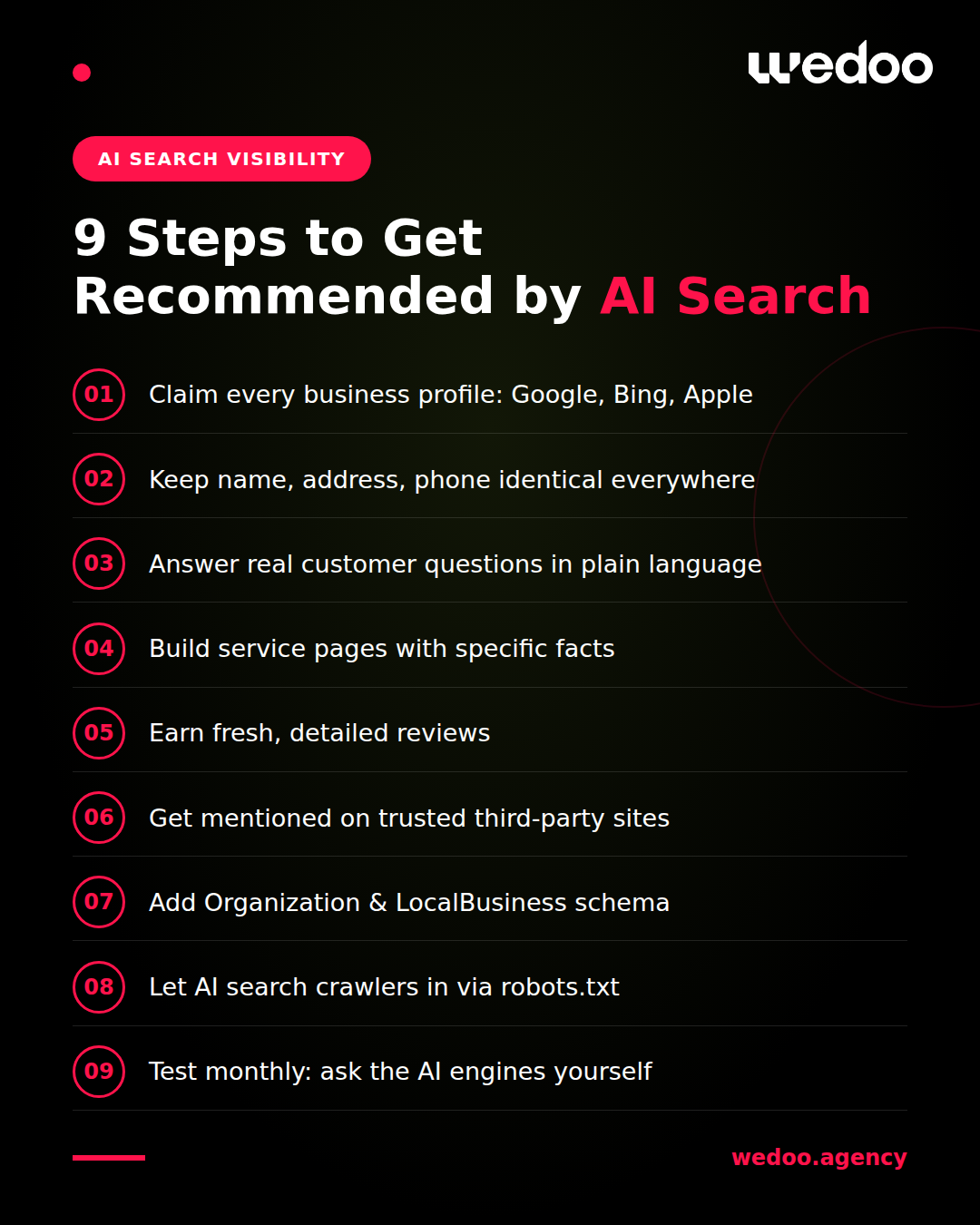
9 steps to get your business recommended by AI search
1. Claim and complete every business profile
Start with the profiles AI engines read directly: Google Business Profile, Bing Places for Business and Apple Business Connect. Fill in every field: primary and secondary categories, services, service areas, hours (including holiday hours), attributes, photos and a description written in plain language.
Google states that "businesses with complete and accurate info are more likely to show up in local search results"
(Google Business Profile Help).
2. Keep your name, address and phone number identical everywhere
AI systems cross-check facts. If one directory lists "Suite 200" and another has an old phone number, the AI has conflicting data and is less confident about you. Audit your listings on Yelp, the BBB, your Chamber of Commerce, industry directories and social profiles, and make them match exactly.
3. Answer the questions your customers actually ask
Collect the questions your sales team hears every week: pricing, timelines, "do you work with…", "what's the difference between…". Answer each one on your site in two or three direct sentences, then add detail below.
Use the question itself as the heading. This answer-first format is what featured snippets, People Also Ask boxes and AI summaries pull from.
4. Build service pages with specific, checkable facts
Create one page per core service, and include:
Who it's for (industries, business sizes)
Where you serve (cities, neighbourhoods, counties)
How it works (your process, step by step)
What it typically costs (price ranges or starting prices)
Proof (named case studies, certifications, years in business)
Specific facts are "quotable". A page that says "Most local SEO projects start showing Map Pack movement within 3–4 months" is far more likely to be cited than one that says "we get results fast."
5. Earn fresh, detailed reviews and reply to them
BrightLocal's 2026 survey found 74% of consumers look for reviews written in the last three months, and 89% expect businesses to respond to reviews (BrightLocal) . AI engines use review text as evidence, too. A review that says "they fixed our walk-in freezer on a Sunday" tells an AI far more than "great service!"
Ask happy customers to mention the service they used and their neighbourhood or town. Reply to every review with a personal, non-templated response.
6. Get mentioned on trusted third-party sites
This is the step most businesses skip, and it's the one that moves AI visibility the most. Aim for mentions on:
Local news sites and business journals (expert comment, community stories)
Chamber of Commerce and business association directories
Industry "best of" lists and association member pages
Partner and supplier websites
Podcasts, webinars and community forums where your customers ask questions
Each independent mention is another vote that confirms who you are and what you're known for.
7. Add structured data to your website
Schema markup gives machines a clean, labelled version of your key facts. At minimum, add:
Organization or LocalBusiness schema (name, logo, address, phone, hours, service area, social profiles via sameAs)
Service schema on service pages
FAQPage schema on FAQ sections
Article schema with a named author on blog posts
Validate everything with Google's Rich Results Test before publishing.
8. Make sure AI search crawlers can reach your site
Check your robots.txt file. Many websites block AI crawlers by accident, often through a plugin or firewall setting. OpenAI explains that sites need to allow OAI-SearchBot to appear in ChatGPT search answers (OpenAI Help Center). Bing's crawler (Bingbot) powers Copilot, and Googlebot covers Google's AI features.
Also make sure your key content is in the page's HTML, not hidden behind scripts, tabs or images. If a crawler can't read it, an AI can't quote it.
9. Test it yourself every month
Once a month, ask ChatGPT, Gemini, Perplexity and Copilot the questions your customers would ask, for example "best [your service] in [your city]". Note:
Are you mentioned?
Which competitors are?
Which sources does the AI cite?
Those cited sources are your to-do list. If an AI keeps citing a particular directory or local article, work on getting listed or featured there.
What should you not do?
Don't buy fake reviews or mass-produced links. Google states there is "no way to request or pay for a better local ranking" (Google). AI engines are built to ignore manipulation too.
Don't publish thin, AI-spun articles. Generic content with no first-hand experience gives AI engines no reason to cite you over a thousand identical pages.
Don't trust anyone who "guarantees" AI placement. No one controls what these systems say. What you can control is how clear, consistent and well-corroborated your business is.
How long does it take to show up in AI answers?
It depends on how established your business is online. Fixing profiles, consistency and crawler access can show up within weeks, because AI engines re-read sources often. Building third-party mentions and review volume takes months. Treat it like SEO: a steady, compounding effort rather than a one-off project.
Frequently asked questions
Is AI search optimization different from SEO?
It builds on SEO rather than replacing it. The foundations are the same: a crawlable site, helpful content and authority. AI search optimization (often called AEO or GEO) adds extra focus on answer-first formatting, consistent facts across the web and earning third-party mentions that AI engines can cite.
Can I pay to be recommended by ChatGPT or Google AI Overviews?
Not in the organic answers. Ads are starting to appear alongside some AI results, but the recommendations themselves are drawn from sources the AI trusts. Your job is to become one of those sources.
Do small businesses really show up in AI answers?
Yes, especially for local and specialist questions. For "near me" and "in [city]" queries, AI engines lean heavily on Business Profiles, reviews and local mentions, where a well-run small business can outshine a bigger brand.
How do I know if AI is sending me traffic?
In Google Analytics 4, look for referral traffic from chatgpt.com, perplexity.ai, gemini.google.com and copilot.microsoft.com. Also ask new leads how they found you, because many AI-driven visits show up as direct or branded search.
Want to know what AI says about your business?
Wedoo will run a free AI search visibility check: we'll ask the major AI engines the questions your customers ask, show you where you appear (and where competitors do), and give you a prioritised fix list.
Make sure AI recommends you, not your competitors.
Wedoo helps businesses get found, trusted and cited by AI search engines like ChatGPT, Gemini and Google AI Overviews. Start with a free AI search visibility check and a prioritised fix list you can act on this month.