Social media marketing converts followers into customers when it treats platforms as a sales channel, not a popularity contest. That means auditing what you actually measure, mapping the real path a follower takes before they buy, building content for every stage of intent, removing friction at the moment someone is ready to act, and systemizing follow-up so interest doesn't evaporate. This guide breaks that down into a 5-step framework you can apply this week, regardless of platform or industry.
The Problem: Why Most Social Media Marketing Doesn't Convert
Most businesses can tell you their follower count. Far fewer can tell you how many customers social media actually generated last month. That gap is the entire problem with how social media marketing usually gets run: it's optimized for attention, and attention is not the same thing as revenue.
The numbers back this up starkly. A social post can rack up hundreds of likes and generate zero site visits, zero DMs, and zero sales, because engagement in 2026 is easier to inflate than ever, through bots, low-effort comments, and algorithmic amplification of shallow interactions. Meanwhile, a modest post that reaches the right ten people at the right moment can outproduce it on actual conversions. Average social media conversion rates hover around 3% across platforms, with e-commerce specifically landing between 2% and 5% depending on execution, which means the vast majority of followers a brand accumulates will never buy anything unless something in the strategy is deliberately built to move them there.
This is not an argument against social media as a channel. Paid social remains one of the top three ROI-driving channels for both B2B and B2C brands, and social commerce sales are climbing fast. It's an argument against running social media like a popularity contest and hoping it behaves like a sales channel by accident.
~3% Average social conversion rate | 17% Of online sales now via social | 81% Have made a spontaneous social purchase |
The 5-Step Conversion Framework
Turning followers into customers is not a content problem alone. It's a systems problem. The five steps below move in order: each one fixes a specific leak in the path between someone seeing your content and someone buying from you.
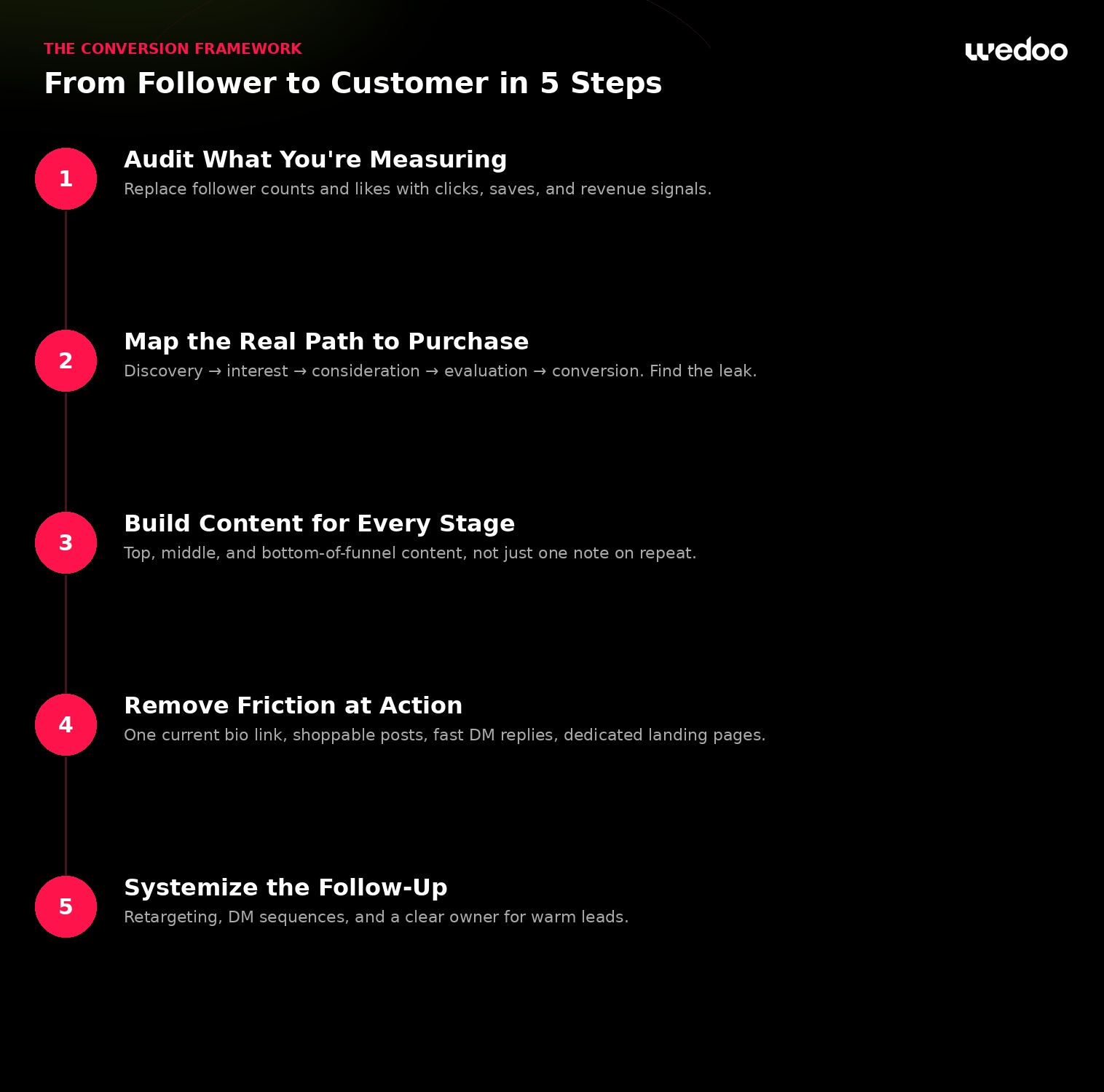
1. Audit What You're Actually Measuring
Before changing a single post, change what's on your dashboard. Follower count, likes, and raw reach are top-of-funnel indicators at best, they tell you content got seen, not that it did anything. In 2026, platforms have shifted from a “follow graph,” where your reach was capped by your subscriber count, to an “interest graph,” where content is judged and distributed based on immediate value to the viewer regardless of who follows you. That makes follower count even less predictive of business outcomes than it used to be.
Replace vanity metrics with signals that sit closer to revenue: click-through rate on links and swipe-ups, saves and shares (which indicate real intent to return to or pass along content), DM and comment quality (a question about pricing matters more than an emoji), and ultimately, conversions tracked all the way to a sale or booked call. If a metric doesn't help you make a decision about what to post next, it's a vanity metric, no matter how good it looks on a slide.
The Three-Question Test for Any Metric
Apply this to anything on your current social media report: Does it drive a decision? Does it connect to a pipeline stage? Does it move with revenue over time? If the answer is no on all three, stop leading with it in your reporting, even if leadership likes seeing it.
2. Map the Real Path from Follower to Customer
A follower signals interest, not intent. Somewhere between that follow and an actual purchase, a real journey happens, and most brands never map it, which means they can't tell where people are dropping off.
Walk it end to end: someone sees a post (discovery), engages or saves it (interest), checks the profile or bio link (consideration), visits the website or DMs a question (evaluation), and eventually buys or books (conversion). Each of those five stages can leak people, and each leak needs a different fix. A weak bio link loses people between interest and consideration. A confusing website loses people between consideration and evaluation. A slow DM response loses people right at the edge of conversion.
Response time is not a soft metric here, it's a hard one: responding to social inquiries within 60 minutes has been shown to lift conversion by roughly 15% compared to slower response windows. Map your own funnel honestly and you'll usually find the leak is not “not enough content.” It's a specific, fixable gap.
3. Build Content for Every Stage of Intent
Most brand social content is written for one audience: people who already know, like, and are ready to buy. That's a small slice of any following. A conversion-first content mix deliberately covers all three intent stages, not just the bottom one.
Top-of-Funnel: Earn Attention Honestly
Educational, entertaining, or genuinely useful content that doesn't ask for anything yet. This is where reach and awareness metrics are legitimately the goal, this content's job is discovery, not conversion.
Middle-of-Funnel: Build the Case
Comparisons, behind-the-scenes process content, and proof, case studies, testimonials, and user-generated content specifically. This matters more than most brands realize: product content featuring a meaningful volume of real customer photos or videos has been shown to convert at roughly triple the rate of brand-only content, because audiences trust other customers more than they trust brand messaging.
Bottom-of-Funnel: Make the Offer Clear
Direct, unambiguous content with a specific next step, a demo, a discount code, a booking link. This is the content most brands are afraid to post because it feels “salesy.” It's also frequently the content most conspicuously missing from an otherwise content-rich social presence.
Not sure which stage of the funnel your current content is missing? Get a free social media strategy session and we'll map your funnel for you.
4. Remove Friction at the Point of Action
This is the step most businesses skip entirely, and it's often the highest-leverage fix available. Someone can be fully convinced by your content and still not convert if the path from “interested” to “bought” has too many steps, or the wrong steps.
Concretely: a single, current, relevant link in your bio, not a generic homepage. Shoppable posts and tags wherever the platform supports them, since shoppable formats consistently outperform standard post formats on click-through. Product-specific landing pages instead of routing every click to your homepage. A fast, human response system for DMs and comments, since slow or absent replies quietly kill conversions that content already earned.
Retargeting Closes the Loop
Not everyone converts on the first visit, and that's normal, not a failure. Retargeting people who engaged with your content or visited your site but didn't convert has been shown to meaningfully lift conversion rates, in some analyses by as much as 70%, making it one of the highest-ROI tactics available once you have even modest traffic volume to work with.
5. Systemize the Follow-Up
Conversion is rarely a single moment. It's a sequence. Someone who commented on a post, watched most of a video, or visited your site from social but didn't buy is not a dead end, they're mid-journey, and the businesses that convert well have a system for staying in front of that person until they're ready.
That system typically includes automated but human-sounding DM follow-ups for common questions, an email or SMS capture point tied to a specific social offer (not just “join our newsletter”), a retargeting audience built from social engagers specifically, and a simple internal process for who follows up on warm DMs and how fast. None of this requires expensive tooling to start. It requires deciding that follow-up is part of the strategy, not an afterthought.
What This Looks Like by Platform
Platform | Avg. Engagement Rate | Best Conversion Lever |
~4.04% | Shoppable posts, carousels, Stories links | |
~3.56% | Video + gated content for B2B lead capture | |
~2.08% | Retargeting ads, reviews, Marketplace/Shop | |
TikTok | Highest video engagement | Product tags, creator/UGC partnerships |
The framework holds across all four. What changes is which lever in Steps 3 and 4 you lean on hardest, video and creator content for TikTok, gated proof content for LinkedIn's longer B2B cycle, shoppable formats for Instagram's more transactional audience.
Common Mistakes That Quietly Kill Conversion
• Reporting on reach alone. If leadership only ever sees follower growth and impressions, the entire team optimizes for the wrong outcome by default.
• One generic bio link for every campaign. Every offer deserves its own destination, not a homepage that makes people search for what the post promised.
• No response system for DMs. A DM asking “how much does this cost” is a warmer lead than most email subscribers, and it often gets answered a day later, if at all.
• Zero bottom-of-funnel content. An entire feed of “value” content with no clear offer anywhere is a brand that's afraid to ask for the sale.
• Treating all engagement as equal. A save or a share signals far more intent than a like, and should be weighted accordingly in how you judge what's working.
Frequently Asked Questions
Q: What is a good social media conversion rate?
A: A general benchmark across platforms sits around 3%, with e-commerce specifically ranging from 2% to 5% depending on execution and industry. B2C paid social campaigns average higher conversion rates than B2B, roughly 2.1% versus 0.9%, reflecting the shorter, less considered B2C buying cycle.
Q: How long does it take to see social media conversions improve?
A: Most businesses see measurable movement within 60 to 90 days of implementing a conversion-focused framework, since it takes time to gather enough funnel data to know which step is leaking the most and to test fixes at each stage.
Q: Should I focus on follower growth or engagement first?
A: Neither, focus on conversion signals first (clicks, saves, DMs, sales), and let follower growth and engagement follow as a byproduct of content that's actually working. Chasing followers directly optimizes for the wrong outcome.
Q: Do I need a large following to convert followers into customers?
A: No. A smaller, genuinely interested audience consistently outperforms a larger, indifferent one on conversion, since relevance and trust drive purchase decisions more than raw audience size.
Q: Which social platform converts best?
A: It depends on your business model and audience, not a universal winner. Instagram and Facebook lead on social commerce and shoppable formats, LinkedIn leads for B2B lead generation, and TikTok leads on engagement and creator-driven product discovery.
Q: How important is user-generated content for conversion?
A: Very. Product content built around real customer photos and videos has been shown to convert at roughly three times the rate of brand-only content, making UGC one of the highest-leverage, lowest-cost levers available.
Q: What's the single highest-impact change most businesses can make?
A: Fixing response time on DMs and comments. A response within 60 minutes measurably lifts conversion, and it costs nothing beyond assigning clear ownership for who answers and how fast.
Q: Is organic social media enough, or do I need paid ads too?
A: Organic content builds trust and top-of-funnel reach, but paid social, particularly retargeting, is where most of the actual conversion lift happens once you have enough traffic to retarget. The two work best together, not as substitutes for each other.
Q: How do I know if my social content is too “salesy” or not salesy enough?
A: If your last ten posts have no clear next step for someone ready to buy, you're under-selling. If every post is a hard pitch with no educational or proof content mixed in, you're over-selling. A healthy mix covers all three funnel stages, not just one.
Q: What tools do I need to start measuring social conversions properly?
A: At minimum, UTM-tagged links on every bio and post link, a connected analytics tool (GA4 or platform-native equivalent) to track what happens after the click, and a simple spreadsheet or CRM to log DM-to-sale conversions manually if you don't have automated tracking yet.
Key Takeaways
• Follower count and likes are top-of-funnel signals at best; they rarely predict actual sales.
• Map the real journey from follower to customer so you know exactly where people are dropping off.
• Content needs to cover all three funnel stages, awareness, consideration, and a clear offer, not just one.
• Friction at the point of action (bio links, DM response time, landing pages) is often the highest-leverage fix available.
• Conversion is a sequence, not a moment. Systemized follow-up and retargeting close the loop on interest that didn't convert immediately.
Ready to turn your followers into an actual revenue channel? Get a free social media strategy session and we'll show you exactly where your funnel is leaking.